
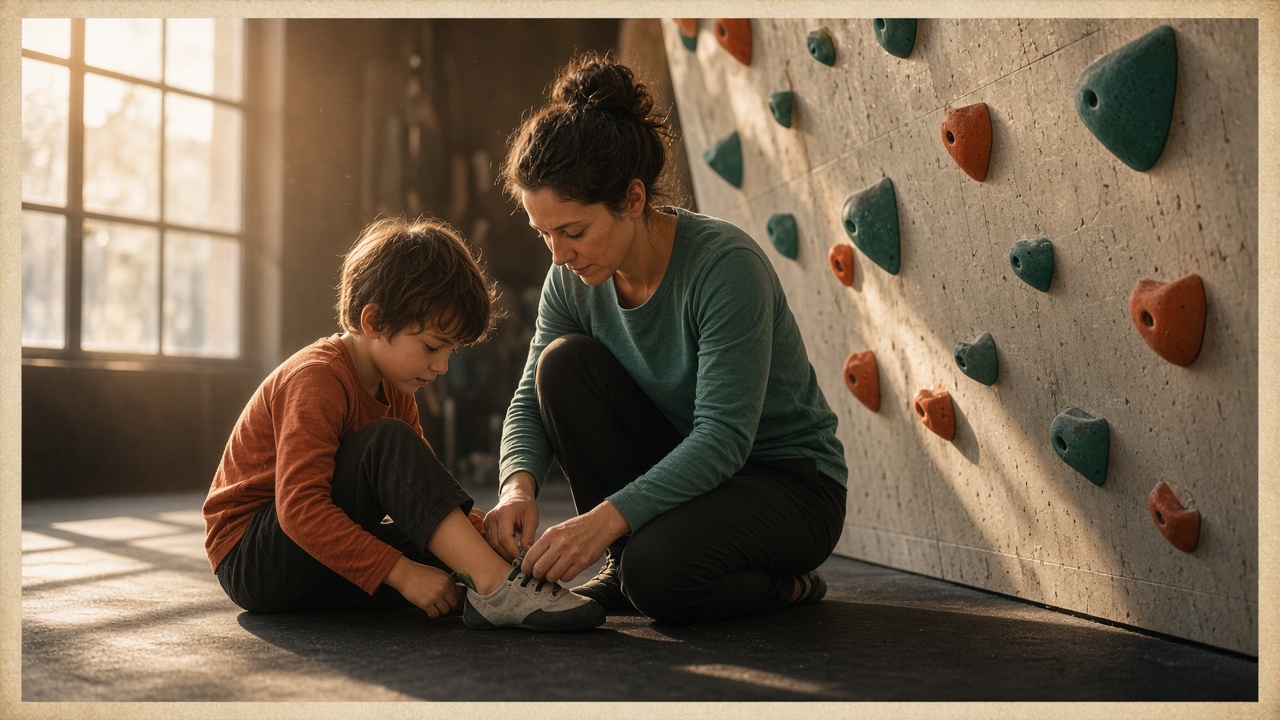
You are lacing tiny shoes in the parking lot while your kid bounces in the back seat, already talking about the new blue problem they almost sent last week. You spot the coach through the gym window, clipboard in hand, and you feel the familiar tug: you have questions, but you do not want to be the parent who disrupts practice or oversteps.
A good relationship with a climbing coach can make youth climbing feel calmer and more coherent for everyone. Your child gets clearer expectations, you get fewer surprises, and the coach gets a partner instead of a guessing game.
This post is a practical playbook for the climbing parent: how to ask better questions, when to bring things up, how to share useful context without micromanaging, and what to do when you disagree.
1) Start by clarifying your shared goal
Before you ask about training plans or competition strategy, anchor the conversation in the long view.
Ask yourself:
- What do we want from climbing this season: joy, confidence, friendships, skill growth, competition results, or a mix?
- What does my kid want right now, not what I want for them?
- What does the program focus on: fun and fundamentals, competition prep, or athlete development over years?
Then bring that to the coach in a sentence.
- Example: "We want climbing to stay fun and keep building confidence. If comps happen, great, but we are not trying to peak at any one event. Does that match how you are coaching this group?"
When you begin here, it becomes easier to discuss everything else: workload, expectations, and boundaries.
2) Pick the right moment and the right channel
Most parent-coach tension is timing, not intent.
Best times to talk
- Before the season starts, or in the first two weeks.
- After practice, when the coach is not actively supervising a group.
- During scheduled check-ins or parent meetings.
- By email or message when you have non-urgent questions.
Times to avoid
- Mid-session when the coach is spotting, belaying, or managing safety.
- Immediately after your child had a hard day and emotions are high.
- Right before a competition run or immediately after a fall.
A simple rule: if safety or attention is required, save the conversation for later.
3) Prepare a short, useful update about your kid
Coaches love information that helps them coach today. They dislike information that implies they are not doing their job.
Useful updates sound like:
- "They slept poorly this week and seem a little flat."
- "We had a growth spurt and shoes suddenly feel tight."
- "They are nervous about lead and asked if they can ease into it."
- "They have soccer tryouts, so energy will be limited for two weeks."
Less useful updates sound like:
- "They need to work on core."
- "They should be doing harder grades."
- "I watched a video and I think their footwork is wrong."
If you want to share a skill observation, ask for the coach's lens instead of presenting a diagnosis.
- Better: "I notice they cut feet a lot when they are tired. Is that something you are already working on?"
4) Ask questions that get you actionable answers
Many parents ask vague questions like, "How is it going?" Coaches answer vaguely because they are busy and because the question is broad.
Try questions that make it easy to respond.
Questions about progress
- "What is one thing they are doing better than a month ago?"
- "What is one habit that would help most in the next four weeks?"
- "Are they at the right challenge level in practice, too easy, too hard, or mixed?"
Questions about confidence and mindset
- "When they get frustrated, what helps them reset?"
- "Do you see them taking healthy risks or staying too safe?"
- "Do you think they respond better to encouragement, specific cues, or quiet space?"
Questions about competition readiness
- "What does a successful comp look like for them this season?"
- "What should we practice at home, if anything, and what should we leave to the gym?"
- "How do you want parents to support on comp day: quiet, cheering, or hands-off?"
Questions about safety and skill progression
- "What milestones do you look for before moving from top-rope to lead?"
- "How do you teach falling, and when does that start?"
- "What are your expectations around belay skills at this age?"
These questions keep the conversation focused on coaching choices, not grades or ego.
5) Understand the coach's constraints
Youth climbing coaches manage more variables than most parents see:
- Group size and safety supervision.
- Different ages and attention spans.
- Access to routes, terrain, and staff.
- Competition calendars and gym schedules.
- The gap between what kids say at home and what they do in the gym.
A productive parent-coach relationship includes respect for these limits.
- Try: "What is the best way to get questions answered without interrupting practice?"
When you ask the coach to design the communication channel, you reduce friction immediately.
6) Use a simple framework for tricky conversations
Sometimes you need to raise a concern: workload feels too high, your kid seems anxious, or you do not agree with an approach.
Use this four-part structure:
- Observation: what you noticed, without judgment.
- Impact: what it affects at home or for your kid.
- Question: ask for the coach's perspective.
- Request: propose a small next step.
Example:
- Observation: "They have been coming home wiped out after practice for the last three weeks."
- Impact: "Homework and bedtime have gotten harder, and they are less excited to go."
- Question: "Is the training load higher right now?"
- Request: "Could we try a lighter week or a modified plan and see if motivation comes back?"
This keeps you aligned with the coach, instead of arguing about who is right.
7) Clarify what coaching means and what parenting means
One quiet source of tension is role confusion.
Coaches handle:
- Skill progression, drills, and safety instruction.
- Group management and practice culture.
- Competition strategy and season planning (depending on the program).
Parents handle:
- Sleep, meals, and schedule stability.
- Emotional support and perspective.
- Logistics: rides, gear, and recovery days.
When parents try to coach technique at home, it often backfires. Kids feel watched. Coaches receive mixed cues. Climbing becomes performance instead of play.
A healthier question is:
- "How can I support the coaching you are already doing?"
8) Talk about expectations early: attendance, effort, and behavior
Many problems explode because expectations were assumed, not stated.
Ask the coach:
- "What does good attendance look like in this program?"
- "What do you want kids to do when they are tired or frustrated?"
- "What behavior crosses the line: unsafe choices, disrespect, distractions?"
- "How do you handle discipline or consequences?"
Then share your family's reality.
- "We have split custody, so every other week has a hard stop at 6:30. Can we plan around that?"
If a coach knows constraints early, they can adjust expectations or recommend another program.
9) Use metrics carefully: effort, not grades
Climbing makes it easy to obsess over numbers: V grades, route colors, rankings. But youth athletes grow in spurts. Confidence swings. Bodies change.
Ask for effort-based indicators:
- Do they try hard things without quitting quickly?
- Do they take feedback and apply it?
- Do they warm up well and stay engaged?
- Do they recover between attempts instead of spiraling?
If you need a concrete target, focus on a process goal.
- "This month we want to practice three good falls on lead, with calm breathing and a reset routine."
10) What to do when you disagree
Disagreement does not automatically mean a bad coach or a bad parent. It means you should slow down.
Step 1: Ask for the coaching rationale
- "Can you walk me through why you are emphasizing power right now instead of technique?"
Sometimes you discover there is a plan you could not see.
Step 2: Check your kid's experience
Ask your child neutral questions:
- "What do you like about practice lately?"
- "What feels hard?"
- "Do you feel supported by the coach?"
Listen without building a case. Kids will tell you what they think you want to hear.
Step 3: Request a small experiment
Instead of demanding a change, propose a trial.
- "Could we try one week focusing on confidence on lead, then revisit?"
Step 4: Know when to switch programs
If safety feels compromised, communication is consistently dismissive, or your child is losing joy over months, it may be time to evaluate a different team or coach.
Switching is not failure. It is good parenting.
11) If your kid is shy, anxious, or sensitive
Some kids will never walk up to a coach and ask for help. They need an on-ramp.
Options:
- Tell the coach: "They freeze when they are embarrassed. A quiet check-in helps."
- Help your kid script one sentence: "Can you watch my feet on this?"
- Ask the coach for a small role: "Could you give them one specific cue each session?"
The goal is not to make your kid tougher. It is to make support easier to access.
12) The long view: what great coaching relationships build
If you do this well, the payoff is bigger than better sessions.
A healthy parent-coach relationship helps your child learn:
- How to receive feedback without shame.
- How to advocate for themselves.
- How to train with patience.
- How to keep sport in perspective.
Years from now, your child may not remember the exact routes they climbed. They will remember whether climbing felt like a place they were understood.
If you are unsure how to begin, start small. Ask the coach one focused question this week, at the right time, with a calm tone. Then listen. Most coaching relationships improve quickly when a parent shows up as a steady partner instead of a second coach.